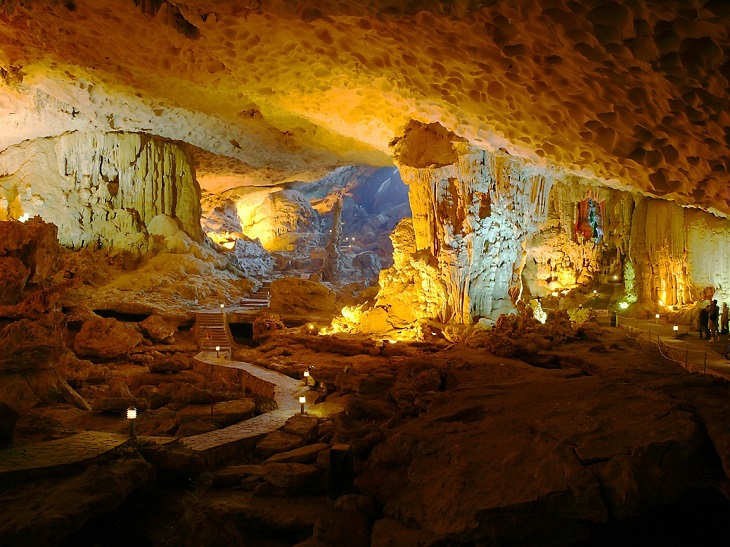
Dau Go Cave is the quiet, history-laden half of Ha Long Bay’s best-known cave pairing. It sits on Dau Go Island, in the western bay, and shares its shore stop with its famous neighbour, Thien Cung Cave — the standard cave call on the classic Route 1, followed by day boats and some overnight cruises. The name means “wooden stakes”: the traditional account links the cave to the ironwood stakes prepared for the 1288 Bach Dang River battle, and that story, more than the formations, is what sets Dau Go apart. Inside, a one-way walk leads through three chambers of quite different character.
Dau Go Cave, on Dau Go Island in Ha Long Bay, is known as the Cave of Wooden Stakes — tradition links it to the stakes prepared under General Tran Hung Dao for the 1288 Bach Dang victory over the Yuan-Mongol fleet. The visit walks through three chambers and is usually paired with Thien Cung Cave on the same island stop.
Dau Go’s claim to fame is its story — the wooden-stakes legend of the 1288 Bach Dang battle — not size or spectacle. The cave has three chambers with distinct moods: a bright entrance hall, a dim pagoda-like passage, and a wide third chamber carved with a petrified battle scene. Dau Go and Thien Cung stand on the same island and are visited in a single shore stop on the classic Route 1; Dau Go is the solemn, older-feeling cave of the pair, and Thien Cung, next door, is the showpiece.
Dau Go Cave at a glance
| Location | Dau Go Island, in the western part of Ha Long Bay (within the Ha Long Bay – Cat Ba Archipelago World Heritage property, first inscribed by UNESCO in 1994 and extended in 2000 and 2023) |
| How you get there | By tender from your boat to the island pier — the visit is organised by the crew |
| Inside | Three chambers walked in one direction: a bright vaulted entrance hall, a narrow dimmer chamber, then a wide third chamber ending at a freshwater well |
| Time needed | One combined shore stop with Thien Cung Cave; most boats allow under an hour inside Dau Go itself, set by the boat’s schedule |
| Access and effort | A flight of stone steps climbs from the pier to the entrance; the path inside is on foot throughout. Shoes with grip are sensible — the stone can be damp |
| Often combined with | Thien Cung Cave, on the same island and the same stop |
Why it is called the Cave of Wooden Stakes
“Dau Go” translates roughly as “wooden stakes”, and a second old rendering of the name, “Giau Go” — hiding the wood — points at the same story. The traditional account holds that General Tran Hung Dao (1226–1300), preparing against the Yuan-Mongol invasions, had ironwood stakes readied and stored here, near the Bach Dang River. In 1288 those stakes, planted in the riverbed, trapped the invading fleet as the tide fell — one of the most celebrated victories in Vietnamese history. Pieces of wood said to have been left behind in the cave gave Dau Go its name. The story is best understood as the traditional explanation of the name rather than documented fact, but it has been attached to the cave for centuries, and it changes how you look at the place: people visit Dau Go as much for a battle story as for its stone. A French volume, Marvels of the World (1938), called it the “Grotte des merveilles” — the cave of marvels.

The three chambers, in walking order
The first chamber: the bright hall
The walk begins in a high, vaulted room full of natural light — the most open-feeling part of the cave. In the very middle stands a colossal pillar that seems to hold the vault up. On top of it, picked out in the stone, is a figure guides point out to every group: a monk in a long, dark cloak, his right hand clasping a cane. Around the walls, the formations take whatever shape your imagination gives them — the game of naming shapes starts here and runs through the whole cave.
The second chamber: the quiet passage
A narrow passage leads into the second chamber, where the light drops and turns mysterious. The stalactites here are smaller and more graceful than in the entrance hall, and the mood changes with them: the stretch feels pagoda-like and hushed, with a meditating monk somewhere in the stone. People tend to lower their voices and walk more gently without being asked.
The third chamber: the petrified battle
The third chamber opens wide, and it is the one the cave’s story has been building towards. Tall stone columns carry carved-looking images of a kingdom mid-battle — soldiers with swords and spears rushing forward, war elephants, horses, lions — all frozen, as if an ancient citadel and its army had been petrified mid-charge. At the far end is a well of clear water. After the dim second chamber, the scale and light here land with real force.
Look for one more thing before you go in: in 1917 Emperor Khai Dinh visited the cave and ordered an engraved stone stele praising Ha Long Bay and Dau Go to be set up beside the entrance. It still stands to the right-hand side of the cave mouth — worth a pause on your way up.

Dau Go and Thien Cung: one island stop, two different caves
Most visitors see Dau Go and Thien Cung together, and the pairing works because the two caves are opposites. Thien Cung, a short walk away on the same island, is the monumental one — vast, brightly lit, with formations arranged like a palace. Dau Go is solemn by comparison, older in feeling and grandiose in a quieter register: lower-key stone, and a legend doing the heavy lifting. If you only have attention for one cave on the stop, choose Thien Cung for spectacle and Dau Go for story. Seeing both takes little extra effort — the boat is already there. Our guide to Thien Cung Cave covers the other half of the stop in the same detail.
Visiting Dau Go Cave: what to know
- How the stop works. Dau Go is a standard call on Route 1, the classic short sightseeing route in the western bay, followed by day boats and some overnight itineraries. There is nothing to book separately — the crew runs the tender ashore and walks the group through both caves.
- Time to allow. The island stop covers both caves; Dau Go itself usually takes under an hour, depending on your boat’s schedule.
- The climb. Stone steps climb from the pier to the entrance, and inside, the path crosses uneven natural cave floor in places. If stairs are a concern, ask the crew before the tender leaves what the stop involves.
- Footwear and light. Wear shoes with grip; the stone can be damp. The second chamber is genuinely dim — give your eyes a moment at the passage rather than hurrying through.
- Crowds. Route 1 is the most accessible route in the bay, and the island receives day-trip groups as well as cruise guests, so the stop can feel busy around midday. Inside, the one-direction flow keeps people moving and the crowd thins quickly.
Dau Go, Thien Cung or Sung Sot?
Travellers comparing cave names on itineraries often mix up three different stops:
| Cave | Character | Where and how it fits |
|---|---|---|
| Dau Go | Solemn and story-led; three chambers and the wooden-stakes legend | Dau Go Island, western bay — paired with Thien Cung on Route 1 day boats and some overnight cruises |
| Thien Cung | The showpiece: huge, bright, palace-like formations | Same island, same stop as Dau Go |
| Sung Sot | The largest cave in the bay; two vast chambers and a climb of about 50 steps | Bo Hon Island, in the central bay — the fixed cave stop on the classic overnight-cruise route |
In short: if your boat follows Route 1, your cave stop is the Dau Go–Thien Cung pair; if you are on an overnight cruise through the central bay, your cave is Sung Sot. The full set is rounded up in our Ha Long Bay caves guides.
A quieter kind of cave
Dau Go will not out-dazzle Thien Cung next door, and it is not trying to. What it offers instead is rarer in Ha Long Bay: a cave where the story comes first — wooden stakes, a river battle, an emperor’s stele by the door — and the stone supports it. If your itinerary includes the island stop, give the third chamber the time it asks for. And if you are still choosing a boat, compare the Ha Long Bay cruise itineraries and check whether the Dau Go–Thien Cung stop is on the route before you book.
Frequently Asked Questions
Why is Dau Go called the Cave of Wooden Stakes?
The traditional account links the cave to the 1288 Bach Dang River battle: General Tran Hung Dao is said to have had ironwood stakes prepared and stored here before they were planted in the riverbed to trap the Yuan-Mongol fleet. Wooden pieces said to have been left behind gave the cave its name. It is a traditional explanation of the name rather than a documented fact.
What is inside Dau Go Cave?
Three chambers in sequence. The first is a bright, high-vaulted hall with a colossal central pillar topped by a monk-like figure. The second, reached through a narrow passage, is dimmer and pagoda-like, with smaller, graceful stalactites. The third opens wide, with tall columns carved into a petrified battle scene of soldiers, elephants and horses, and ends at a well of clear water.
Are Dau Go Cave and Thien Cung Cave visited on the same stop?
Yes. Both caves are on Dau Go Island, and boats following the classic Route 1 visit them in a single shore stop. Thien Cung is the monumental, brightly lit showpiece; Dau Go is the quieter, more solemn cave, visited mainly for its wooden-stakes story.
How long does a visit to Dau Go Cave take?
The island stop covers both Dau Go and Thien Cung. Most boats allow under an hour inside Dau Go itself, depending on the boat's schedule and how long the group spends in the third chamber. There is nothing to book separately — the crew organises the tender ashore and the walk through.
How hard is the climb to Dau Go Cave?
A flight of stone steps climbs from the island pier to the entrance, and inside the cave the path is on foot throughout, on natural cave floor in places. Wear shoes with grip, as the stone can be damp. If stairs are a concern, ask the crew before the tender leaves — they can tell you what the stop involves.
Which is better, Dau Go Cave or Sung Sot Cave?
They are different stops on different routes. Dau Go, on Dau Go Island in the western bay, is the history-led cave of the Route 1 pairing with Thien Cung. Sung Sot, on Bo Hon Island in the central bay, is the largest cave in Ha Long Bay and the fixed cave stop on the classic overnight-cruise route. Most travellers see whichever cave their itinerary's route includes.